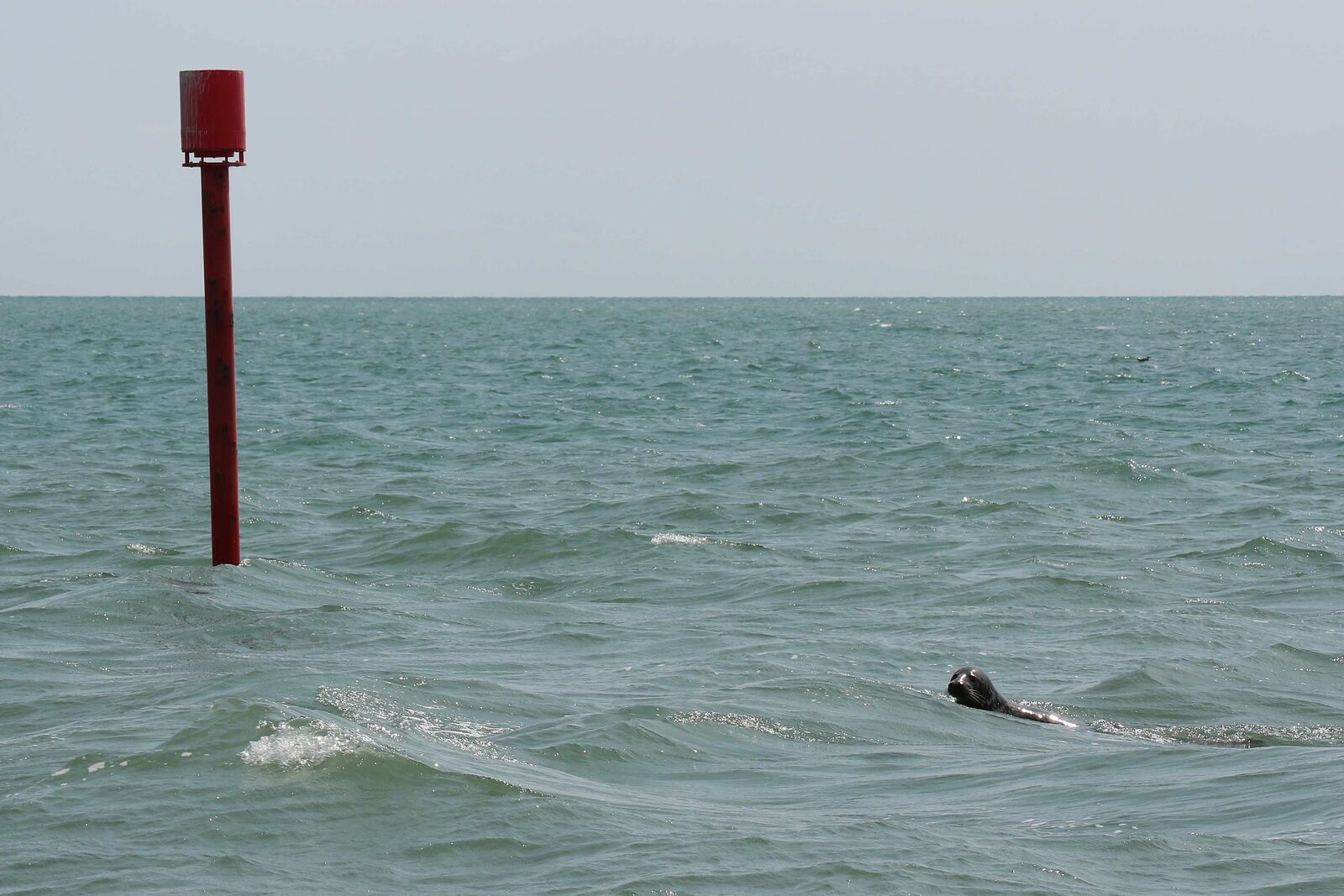
Seals on Seaford Beach — Who to Call and How to Watch Responsibly
Seals are hauling out on Seaford beach again, and in spring 2024 a pup was born near Splash Point. Here is how to tell a grey seal from a common seal, why the Sussex coast is starting to suit them once more, the 100 metre rule that keeps them safe, and the 24 hour number to ring if one is in trouble.
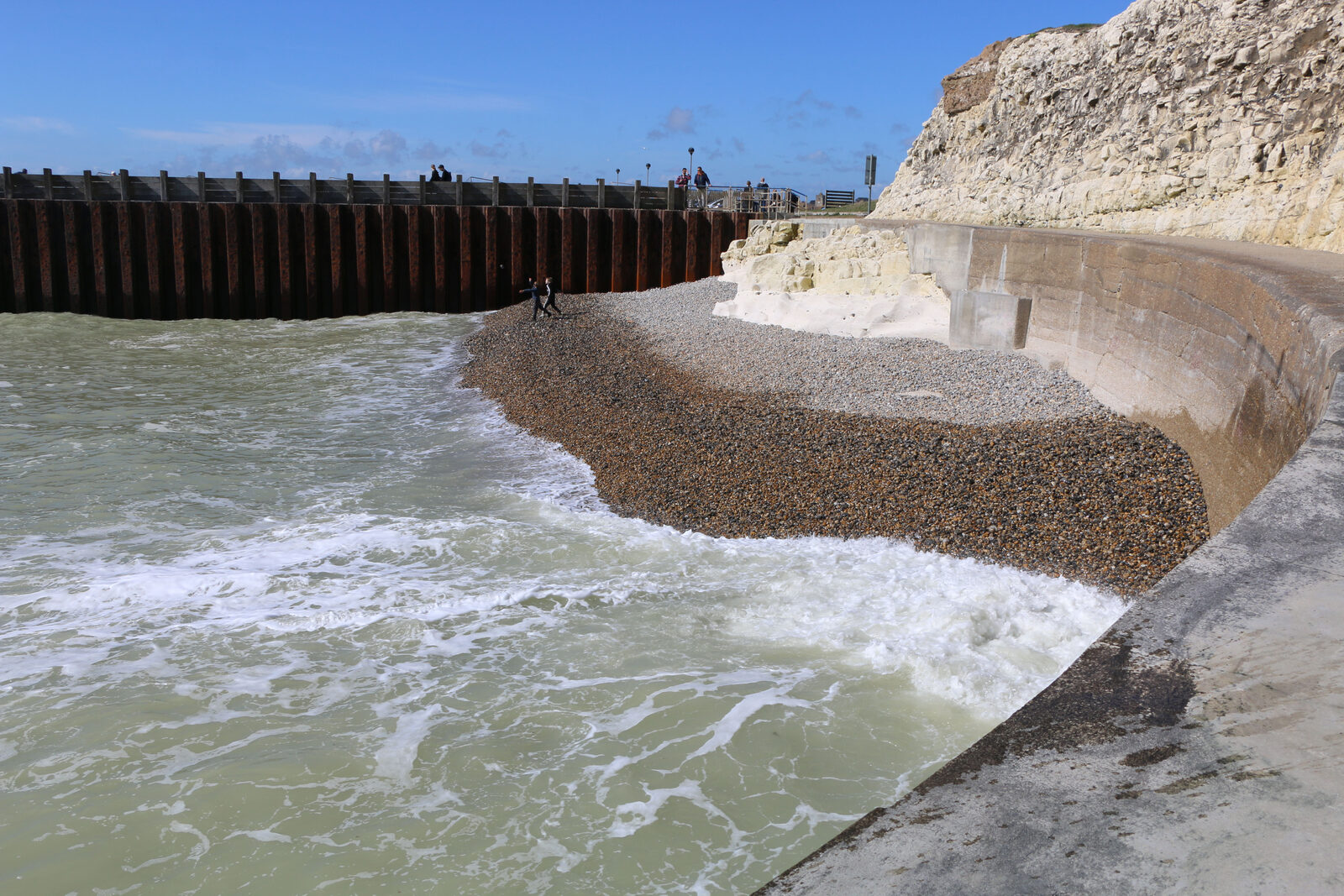
For most of the twentieth century a seal on Seaford beach was a story worth telling in the pub. It is now closer to a regular occurrence: single animals haul out on the shingle below the cliffs, most often in the small bay at Splash Point, and in the spring of 2024 a pup was born there. That is good news for a coast that spent decades being emptied out, and also a problem, because a seal on a busy town beach is a wild animal resting in the worst possible place.
The pup at Splash Point
The clearest local record comes from late April 2024, when a newborn seal was seen with its mother near Splash Point at the eastern end of the beach. I Love Seaford wrote up the sighting on 31 May 2024. British Divers Marine Life Rescue (BDMLR), whose head office sits on Regency Close in Uckfield, roughly fifteen miles north of the town, sent a volunteer down to assess the pair. A BDMLR spokesperson thought "this might be the same seal that was on Seaford Beach a couple of weeks ago", and made the point that matters most: "Seals can get quite stressed with lots of people around."
Renaturing Seaford covered the same run of visits under the banner enjoy, respect, protect. Its photographs were taken on 8 May 2024 by Colin Mitchell using 500mm and 700mm lenses, which is the whole point: the long glass exists so the photographer never has to walk closer. He also recorded what everyone else was doing, which included dogs barking at a resting seal and people edging in for a phone snap.
Grey or common?
Two species turn up in Sussex waters, and the giveaway is the face. A grey seal (Halichoerus grypus) has a long, straight profile, a Roman nose, and nostrils set in two near parallel slits. A common or harbour seal (Phoca vitulina) is smaller, with a shorter, dished, almost dog-like face and nostrils that meet at the bottom in a V.
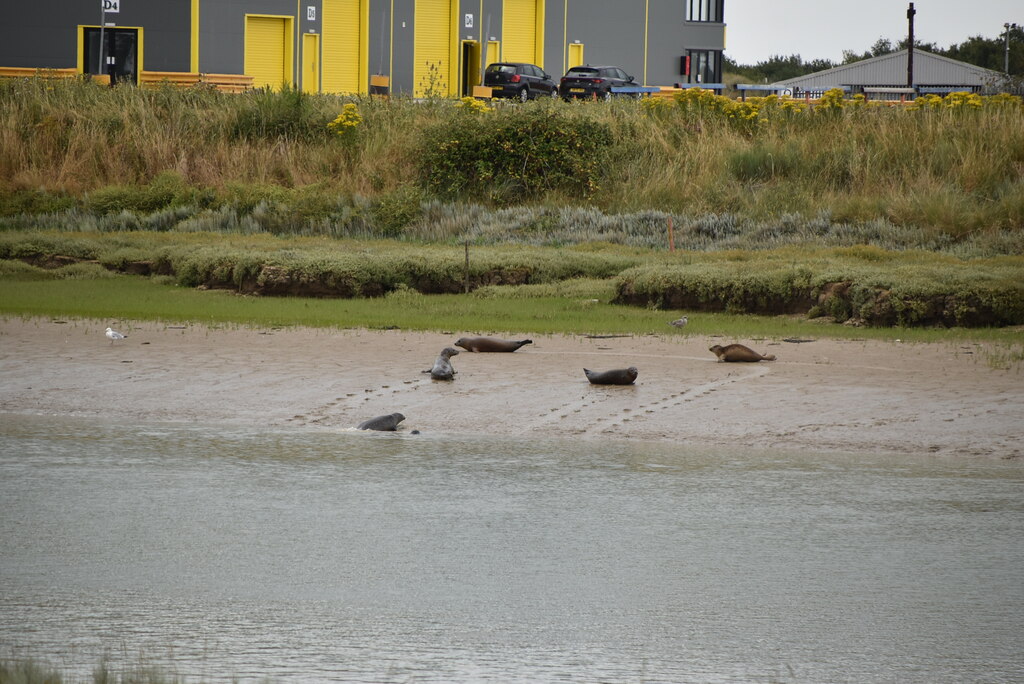
The breeding calendars differ too, which is why the season changes what you should do. Common seal pups are born in June and July and can swim within hours of birth. Grey seal pups arrive in late autumn in a white coat and stay ashore for around three weeks before swimming at all. Sussex Wildlife Trust notes that the only breeding population of common seals on England's south coast is the small group in Chichester Harbour, recently estimated at 23 to 25 animals; grey seals are largely passing through, but the counts have crept up year on year.
Why they are coming back
The seals are a symptom of something happening underwater. By 2019 an estimated 96 per cent of the kelp forest that once ran along the Sussex coast had gone, stripped away by trawling, storms, heatwaves and sediment. On 18 March 2021 the Sussex Nearshore Trawling Byelaw closed 304 square kilometres of seabed from Chichester to Rye, and Sussex IFCA reports no records of trawling inside it in the five years since.
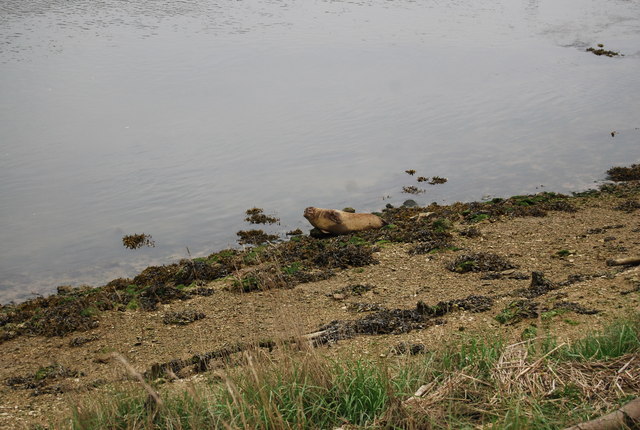
Seaford also sits inside the Beachy Head West Marine Conservation Zone, designated in 2013, which covers some 24 square kilometres of chalk reef, mussel bed and native oyster ground between Brighton Marina and Beachy Head. More habitat means more fish, and more fish means seals. Nor do they stop at the shoreline: one was photographed on the bank of the Sussex Ouse near Southease in April 2011, miles inland from Newhaven.
The five S's
BDMLR compresses its guidance into five words.
- Stop. Do not approach, and do not let children or dogs near.
- Space. Keep 100 metres. Binoculars or a zoom lens close the gap at no cost to the animal.
- Silence. A startled group can stampede into the sea and injure itself on the shingle.
- Sleep. A hauled out seal is conserving energy, and every disturbance is a withdrawal from that account.
- Support. If you are worried, call rather than intervene.
Dogs are the recurring problem. Keep them on a lead near a seal, as much for the dog as for the seal: a cornered seal bites hard, and the bacteria in its mouth cause a serious infection.
When to call, and what to say
The BDMLR hotline is 01825 765546, staffed 24 hours a day, and it puts you through to the nearest trained Marine Mammal Medic. The charity was formed in 1988 by a handful of divers responding to a mass die-off of harbour seals in the Wash, and now trains over a thousand new medics every year.
A seal probably needs help if it is a white-coated pup alone in autumn or winter, if it is under a metre long and alone between June and August, or if it is visibly thin, coughing, cloudy-eyed, or tangled in netting or line. Give the operator an accurate location, the species if you can tell, and a description of the animal. Do not handle it, and never push a seal back into the water. If it is a pup, the operator may ask you to stop it reaching the sea using a board, but do that only if you are told to.
What the law actually covers
Seals here are protected by the Conservation of Seals Act 1970, and the Conservation of Seals (England) Order 1999 extends year-round protection from being killed, injured or taken along the coast from Berwick-upon-Tweed round to Newhaven, a stretch that takes in Seaford. What the Act does not contain is any offence of disturbance in England. Standing over a resting seal until it bolts for the sea is not illegal. That is why the 100 metre rule is guidance rather than law, and why a seal at Splash Point depends on whoever is on the beach that morning.
Watching well
For Seaford that means watching from the promenade or the top of the steps rather than the shingle, using the zoom, and keeping the dog on a lead at the Splash Point end. Do not post a pin-accurate location while the animal is still there. Sightings are worth passing to Sussex Wildlife Trust's Living Seas team or to Seaford Natural History Society. And if in doubt, the number is 01825 765546.
Sources
- Seals Spotted on Seaford Beach (opens in a new tab), I Love Seaford, 31 May 2024 (also held in the Discover Seaford local archive)
- Seaford Seals: enjoy, respect, protect (opens in a new tab), Renaturing Seaford
- What To Do If... (opens in a new tab) and About BDMLR (opens in a new tab), British Divers Marine Life Rescue
- Sussex Seals (opens in a new tab), Charlotte Owen, Sussex Wildlife Trust, 15 August 2019
- Harbour Seal (opens in a new tab), Sussex Wildlife Trust
- The Sussex kelp recovery story, five years in (opens in a new tab), Sussex Wildlife Trust
- Marine Protected Areas (opens in a new tab), Sussex IFCA
- Beachy Head West (opens in a new tab), Wikipedia
- Conservation of Seals Act 1970 (opens in a new tab), legislation.gov.uk
- Hero image: Seal by Norman's Bay by Oast House Archive / Geograph (opens in a new tab) / CC BY-SA 2.0 (opens in a new tab)