The Fitzgerald Almshouses — Croft Lane's Gothic Charity (1864)
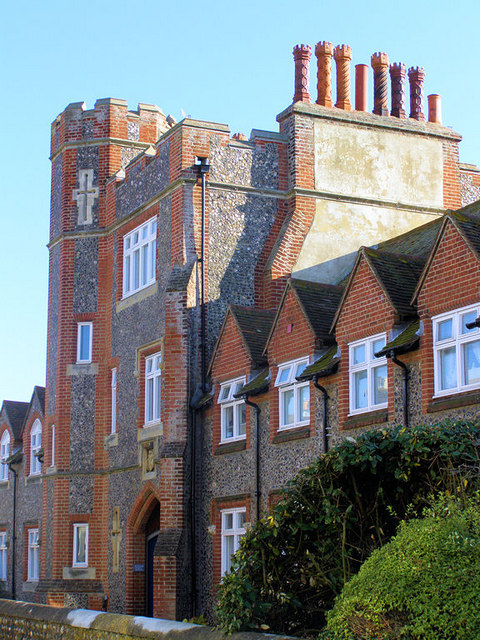
In 1858 John Purcell-Fitzgerald, elder brother of the poet who translated the Rubaiyat of Omar Khayyam, signed away more than fifty properties to house Seaford's labouring poor. Six years later the castellated almshouses rose in Croft Lane, flint and red brick with mock-Tudor chimneys and the Fitzgerald war cry carved above the arch. They are still housing people in need today, freshly rebuilt at a cost of nearly two million pounds.
The Brother Nobody Remembers
In 1859 a slim anonymous pamphlet called *The Rubaiyat of Omar Khayyam* appeared in London and sold almost nothing. Its translator was Edward FitzGerald, a Suffolk recluse who would end up one of the most quoted poets in the English language. His elder brother John is remembered by nobody at all. Yet it is John, not Edward, whose family war cry is carved into a stone shield in Croft Lane, Seaford.
John Purcell-Fitzgerald was born at Bredfield in Suffolk in 1803 and died in 1879. One family account calls him "easily the most eccentric of a peculiar lot", which was a considerable claim in a household of nine children. He was schooled at Bury St Edmunds and went up to Trinity College, Cambridge, taking his BA in 1826 and his MA in 1829. A bout of brain fever damaged his eyesight and left him with a speech impediment, neither of which stopped him becoming a lay preacher with a real following among evangelical audiences in the 1840s, mostly on the subject of biblical prophecy.
The family name had been Purcell until 1818, when John's father adopted the surname Fitzgerald. John himself became Purcell-Fitzgerald in 1858. It was his father who first brought the family south to Seaford, drawn by the fact that the town was a pocket borough and therefore a reliable route into Parliament. The Fitzgeralds stayed long after reform closed that particular door.
A Deed Dated 14 August 1858
By the 1850s John owned Corsica Hall in Seaford, then still known as Millberg, alongside Boulge Hall in Suffolk and Castle Irwell near Manchester. He was not a careful man of business: the loss-making Pendleton Colliery had bankrupted him in 1849. What he did next in Seaford was, by contrast, built to outlast him by well over a century.
On 14 August 1858 he executed the deed that created the Fitzgerald Charity, endowing it with more than fifty properties and parcels of land. The object was precise: to care for the labouring poor of good character, aged over 60, living within nine miles of Seaford. An applicant had to be certified by a doctor as "a proper object of it". Once admitted, a resident could be removed for "drunkenness, profane swearing or other act of immorality or of habitual gross misconduct". Victorian charity arrived with conditions attached.
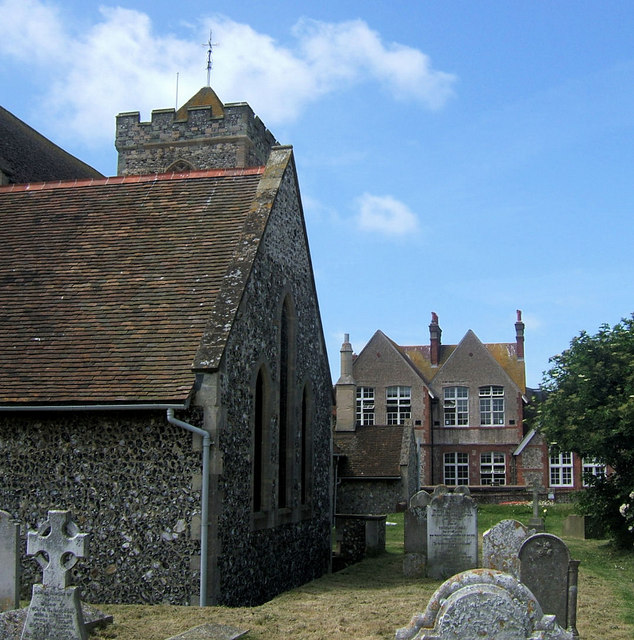
His other Seaford gifts were smaller but of a piece: a Lending Library for the Poor in Church Street, and £100 towards the restoration of St Leonard's Church in 1861 and 1862.
Flint, Brick and "Crom a boo"
The almshouses were built in Croft Lane in 1864, and they are anything but apologetic. Historic England listed them Grade II on 23 March 1989 (list entry 1039983), filed under the splendidly misspelt name "Numbers 1-14 Fizgerald House". The official description reads like a Gothic shopping list: flint with red brick dressings and a tiled roof, two two-storey wings linked by an elaborate three-storey tower, an octagonal corner turret with a crenellated parapet and lancet windows, pointed latticed casements set in gabled dormers, hood mouldings on corbels, and six elaborate terracotta chimneypots to either side.
Look closely at the flintwork and you can see the builders showing off: rough field flint along the road frontage, neatly knapped flint on the building itself. Above the pointed archway to the right of the turret sits a stone shield bearing the motto crom a boo, the Fitzgerald family war cry, and it appears again on the shield in the central window of the former warden's house at the far right of the range.
Nineteen Rooms and Four Sculleries
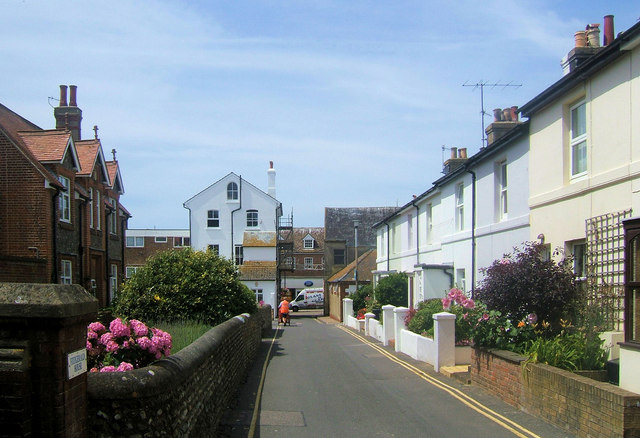
The original building contained nineteen rooms. Standing in Croft Lane and facing the tower, there were four double rooms with four larders to the left, and four double rooms with four sculleries to the right. The tower itself held one double room on the ground floor, a double and a bedsit on the first, and two bedsits on the second. Building continued in phases right through to 1893 as the endowment income allowed.
The House That Paid For It
The Fitzgerald name is still all over the map of Seaford: Corsica Road, Fitzgerald Avenue, Fitzgerald Park. That is not sentiment, it is arithmetic. As local historian Charlie Grimble argued in a Seaford Museum talk at the Little Theatre on 8 August 2025, the charity became the largest property portfolio in the town, and its land dealings helped push Seaford from a sleepy fishing village into a Victorian town beside the sea.
Still Working, 168 Years On
Registered charity number 207524 is very much alive. Over the years the trustees converted property sales into investments, which funded major renovations in 1959 and again in 1982. Then in 2016 they went back to first principles: strip each of the fourteen units to its structural shell and rebuild to modern standards while keeping the historic fabric.
It took nine years and four phases. Structural reinforcement, insulation, damp-proofing, roofs and chimneys, new services, better layouts. The Almshouse Association approved a £100,000 interest-free loan in December 2024 to cover a £52,000 shortfall on the final phase and let the trustees reinstate heritage features rather than value-engineer them away. The total came to £1.946 million, roughly £139,000 a unit, and the work completed in October 2025. Residents aged between 66 and 93 were moved around the site rather than out of it, and not one was lost over the nine years. Turnaround on a vacancy now averages about a week.
For the year ending 31 March 2025 the charity reported income of £77,401 against expenditure of £57,297, run by nine trustees, none of whom take a penny.
Seeing Them
The almshouses stand on Croft Lane in the old town centre, a couple of minutes' walk from St Leonard's Church, at grid reference TV 484 990. They are stop 10 on the Seaford heritage trail. They are also people's homes, so admire the chimneys and the crom a boo shield from the pavement and leave it at that. Seaford Museum sells a booklet, *Seaford Almshouses and the Fitzgeralds*, for anyone who wants the full story.
Sources
- Historic England list entry 1039983: Numbers 1-14 Fizgerald House, Croft Lane, Seaford
- Seaford Heritage Walks: Fitzgerald Almshouses
- Charity Commission: Fitzgerald Charity, registered number 207524
- The Almshouse Association: Association £100,000 loan helps complete £1.946m restoration
- Wikipedia: John Purcell-Fitzgerald
- Seaford Museum: 'The impact of the Fitzgerald Charity on Seaford's Victorian development', talk by Charlie Grimble, 8 August 2025
- seafordtimes.com, 'Alms Houses' page (archived), Discover Seaford project archive