Charles Bravery and Seaford's Cinema Dynasty
In 1913 Charles J. Bravery built the Empire cinema on Sutton Road. Two decades later his son Victor headed off an Odeon and built the Ritz on Dane Road. How one family kept Seaford's picture houses in local hands, and what a Seaford postman really thought of them.
Seaford has had three cinemas in its history, and one family stood behind two of them. Charles J. Bravery built the Empire on Sutton Road in 1913. His son Victor, working the town's property market a generation later, made sure it was the Braverys and not the Odeon chain who gave Seaford its big art deco picture palace in 1936. This is the story of the father and son who kept Seaford's cinema business in local hands for a quarter of a century.
A Company for an "Electric Theatre"
On 22 February 1913, Charles J. Bravery joined H. Ediss and F. Ediss to register the Seaford Empire Company Limited, with capital of £3,000, "for the purpose of erecting an electric or cinematograph theatre." Moving pictures were still a novelty in small seaside towns, and Seaford's only picture house until then had been a basic theatre in Brooklyn Road.
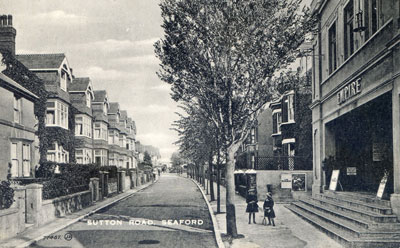
The building went up on Sutton Road that same year. It cost £1,975, measured 72 feet deep by 32 feet wide, and held about 500 people across stalls and a balcony. Local advertising called it "the pinnacle of kinematographic perfection." Inside there was a kiosk in the middle of the foyer, plaster motifs on the balcony front and dome-shaped lights in the ceiling, and the programme mixed silent films with live stage turns.
Landlord, Not Showman
Seaford Museum describes Charles Bravery as "an influential local businessman," and the detail that matters is that the Braverys owned the Empire rather than running it. As his father's affairs grew, C. Victor Bravery supervised the family's business interests, and the Empire was let to operators who took the risk of filling the seats.
The first of them was remarkable: a 20-year-old from Birmingham named Oscar Deutsch, who would go on to found the Odeon chain. His company, Cinema Services (Birmingham) Ltd, was still running the Empire around 1930. Around 1931 the lease passed to Mrs I. Merriman Langdon, and by the early 1930s the Empire had British Thomson Houston sound equipment for the talkies.
The Braverys and the Army Huts
The family's wider fortune seems to have been made in property. In June 1974, members of Seaford Museum interviewed George Martin (1908-1976), a Seaford postman, about the town of his youth. He remembered the end of the First World War, when the huge training camps on the edge of town were emptied:
> "The Bravery family walked in after the 14-18 war and bought up all the old army huts and the ground that they stood on, then they started the demolition and one thing led to another."
Martin was not a fan. "They never put a foot wrong," he said, "especially Victor Bravery, the one that owned the Ritz. He was a pig of a man." It is one voice, recorded fifty years after the fact, but it is the most vivid first-hand account of the family that survives in print, and it places the Braverys at the centre of Seaford's post-war rebuilding.
Heading Off the Odeon
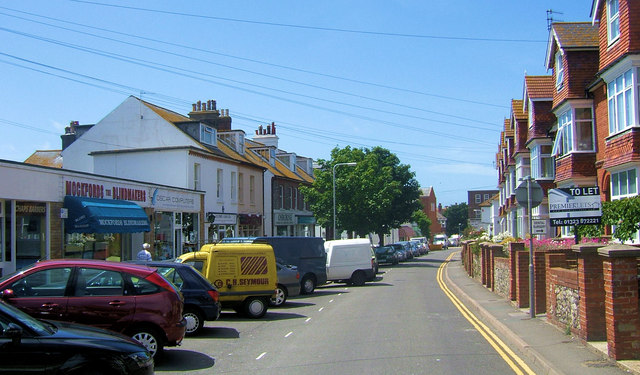
By the mid-1930s Oscar Deutsch was building Odeons across the country, and his company planned one for Seaford on the corner of Dane Road and Pelham Road. For Mrs Langdon at the ageing Empire, a brand-new Odeon would have been ruinous.
Victor Bravery offered her a deal. If she could persuade Deutsch not to go ahead with Odeon Seaford, he would buy the site himself and build her a brand-new cinema to lease. Deutsch dropped the scheme. The plot was an unlikely one: it lay some way from the commercial centre and had recently been the town pound, where stray cattle were penned.
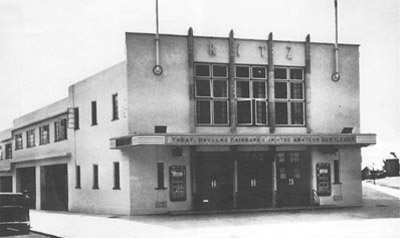
On 6 February 1936, the foundation stones of the new Ritz were laid by Tom Godfrey JP and C. J. Bravery, so the old man's name went into the new building too. It opened to the public about five months later. (Some cinema listings date the Ritz to around 1932, but the Seaford Times history, compiled with local researcher Charlie Grimble, gives 1936, and an early photograph shows Douglas Fairbanks Jr in *The Amateur Gentleman*, a 1936 release, on the canopy.)
Designed by Major William James King, the Ritz seated 879 on a semi-stadium plan, with a raised, stepped section at the rear instead of an overhanging balcony. It had a 45-foot proscenium, a 20-foot stage with two dressing rooms, and its own café and dance hall.
One Cinema for Forty Years
The Braverys briefly owned two cinemas. Then, in the early hours of 1 March 1939, fire gutted the Empire, killing volunteer fireman Fred Mace, and it never reopened. The Ritz served Seaford alone for the next forty years. It screened Gaumont-British News until 1947, then Movietone and British Paramount News, added CinemaScope in 1955, and even hosted a season-long ice show in 1977. Later operators included Hallmark Cinemas (1970-1974) and the Miles Byrne Group (1974-1979). It closed in December 1979 and was demolished.
What We Still Don't Know
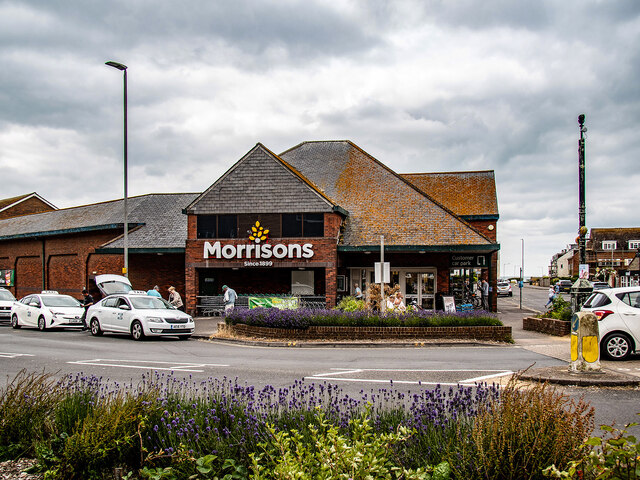
Neither Bravery building survives: the Empire's site on Sutton Road is a small car park, and Morrisons now occupies the Ritz plot. Much about the men themselves remains unrecorded online, including birth and death dates, other property ventures and any surviving family photographs. Seaford Museum at the Martello Tower holds the town's cinema records. If you are a Bravery descendant, or remember Victor, Discover Seaford would love to hear from you at [email protected].
Sources
- Seaford Museum & Heritage Society, "Empire Cinema": seafordmuseum.co.uk/empire-cinema
- Seaford Times (archived), "The Seaford Cinemas," compiled with Charlie Grimble: seafordtimes.com/seaford-history/cinema
- Cinema Treasures, "Empire Cinema, Seaford": cinematreasures.org/theaters/41295
- Cinema Treasures, "Ritz Cinema, Seaford": cinematreasures.org/theaters/41296
- Sussex History, "The Trouble with Seaford" (George Martin interview, 1974): sussexhistory.net
- Discover Seaford project archives, recovered pages from seafordtimes.com and seaford-sussex.co.uk