The Johnnie Walker "Striding Man" Was Drawn in Seaford
The Johnnie Walker Striding Man is one of the most recognised logos on earth, and the version still in use was drawn by Leo Cheney, a cartoonist who lived on Sutton Avenue and is buried in Seaford Cemetery. The story of how a Lancashire bank clerk gave a global whisky brand its definitive walk, with a final chapter in a quiet Sussex town.
Pour a glass of Johnnie Walker almost anywhere in the world and you are holding a piece of Seaford history. The brand's monocled, top-hatted "Striding Man," forever marching forward with his cane and his confident grin, is one of the most recognised commercial logos ever drawn. The version that fixed him in the public imagination, the rounded, genial gentleman still walking across bottles and billboards today, was the work of a cartoonist who spent the last years of his life at a house on Sutton Avenue and now lies in Seaford Cemetery.
A familiar figure with a local address
His name was Leo Cheney. Between 1923 and his death in 1928 he owned the property that stood on the site of the building now called Cheney's Lodge, at 24 Sutton Avenue. It is an ordinary residential street in a quiet seaside town, and yet for those few years it was home to one of the busiest commercial illustrators in Britain. Most residents walking past today have no idea that the man who shaped a global icon once lived a few doors along.
From an Accrington bank to Fleet Street
Cheney was born in Accrington, Lancashire, in 1878. He attended the local grammar school and began working life as a bank clerk, drawing in his spare time. The hobby grew into a career. He became a staff cartoonist on the Manchester Evening News and went on to contribute to some of the most widely read publications of the Edwardian and First World War years, including The Passing Show, Punch and the Illustrated London News, where his Johnnie Walker advertisements ran between roughly 1915 and 1919. By the time he moved south to Seaford he was a professional at the height of his trade.
The Striding Man before Cheney
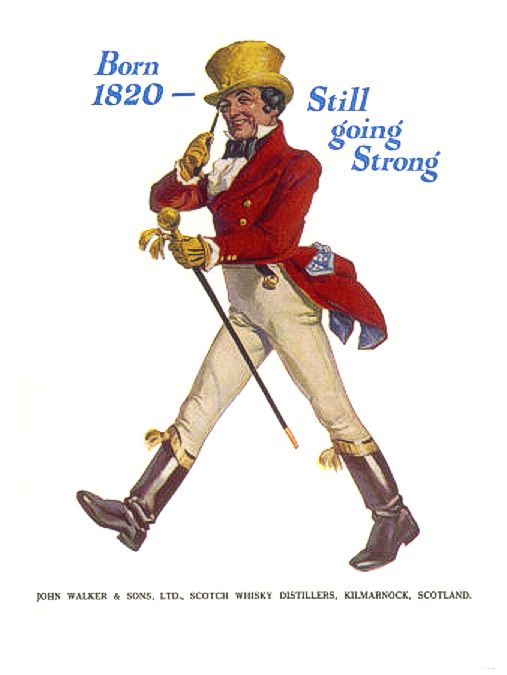
Cheney did not invent the Striding Man, and it is worth being precise about that. The figure was first sketched in 1908 by the Nottingham illustrator Tom Browne (1870-1910), reputedly dashed off during a lunch meeting with the whisky firm's directors. Browne gave John Walker and Sons a jaunty Regency dandy striding to the right, and the slogan "Born 1820, still going strong" turned the drawing into a statement about the brand itself. Browne died young, in 1910, and for a few years the cartoonist Bernard Partridge of Punch took the figure on.
Cheney makes the man his own
It was Cheney who gave the character the warmth that made him last. Where Browne's man had been spry and slightly caricatured, Cheney rounded him out into a fuller, more sociable figure, softened the line, and brought colour and a sense of adventure to the advertising. This is the Striding Man who carried Johnnie Walker through the 1920s and into its golden interwar era, and the essential shape of him has survived every redesign since. The polished, fully realised version is usually dated to the late 1920s, around the time of Cheney's death in 1928 (some brand histories place the definitive redesign in 1929), after which the firm kept his template and refined it rather than replacing it.
The logo was retired and then revived over the decades, modernised by the agency Bartle Bogle Hegarty in 1996 for the "Keep Walking" campaign and refined again in 2015, but he never strayed far from the figure Cheney established. Diageo, which owns the brand today, still markets a "Striding Man" edition. For a town that rarely features in the story of global advertising, it is a remarkable thread to hold.
A quiet grave above the town
Leo Cheney died in 1928, aged about fifty, and was buried in Seaford Cemetery, the large municipal burial ground that opened off the Alfriston Road in 1897. He shares the cemetery with several other notable Seafordians, among them the balloonist Henry Coxwell, who set a world altitude record in 1862. Cheney's resting place is unmarked by any fanfare, which feels fitting for a man whose most famous creation carries no signature at all and yet is seen by millions every day.
Where to find the connection today
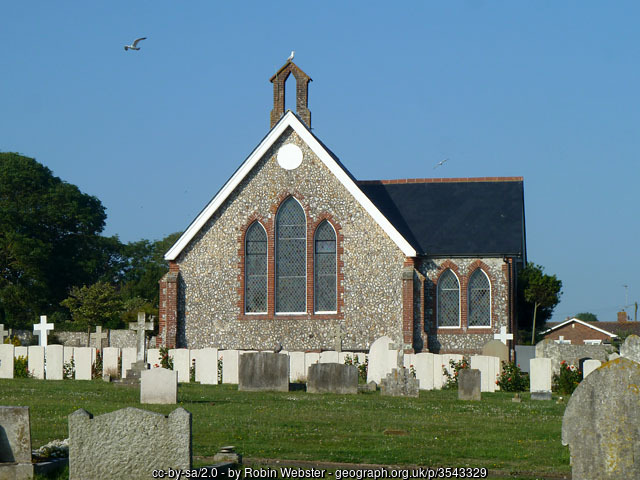
There is no blue plaque on Sutton Avenue, and the Striding Man's Seaford chapter goes largely unrecorded on the bottle. But the connection is real and checkable: a Lancashire bank clerk turned national cartoonist, a few productive years at a house on a Seaford side street, and a final resting place in the town cemetery. Next time the familiar little gentleman strides past on an advertisement, it is worth remembering that he learned his definitive walk a short distance from Seaford seafront.
Sources
- Seaford's notable residents, archived from seaford-sussex.co.uk, held in the project archive at `Thoughts-Ideas-Expansion/archives/seaford-sussex-co-uk.md`
- "A Visual History of Johnnie Walker's Striding Man Logo," VinePair
- "The Man Who Never Stops: How the Striding Man Defined Johnnie Walker," The Whiskey Wash
- "Johnnie Walker marks 110 years of the Striding Man," The Spirits Business
- Johnnie Walker, Wikipedia
- Seaford Cemetery history, Seaford Town Council