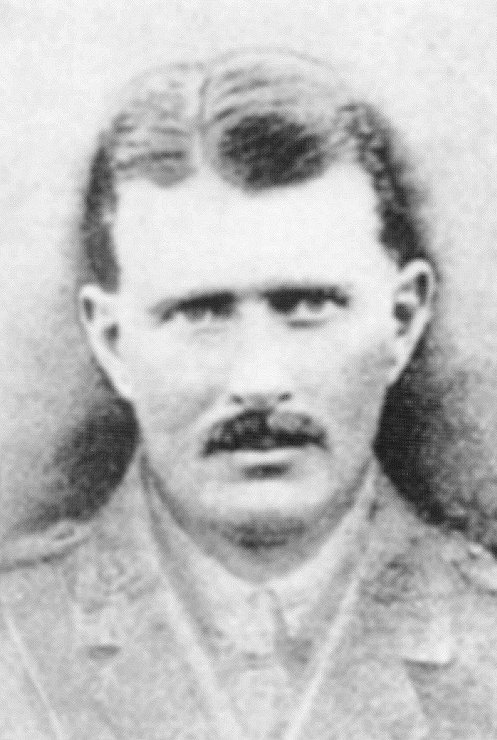
Cuthbert Bromley VC — Seaford's "Six VCs Before Breakfast" Hero
Major Cuthbert Bromley, whose family home was Sutton Corner, is the only Victoria Cross holder commemorated on Seaford's war memorial. In April 1915 he helped the Lancashire Fusiliers fight ashore at W Beach, Gallipoli, in the action remembered as the regiment's "six VCs before breakfast," then died when his troopship was torpedoed that August. A century later the town laid a commemorative paving stone in his name.
The Name on Sutton Park Road
On the granite war memorial cross at the junction of Sutton Park Road and Avondale Road, among more than a hundred Seaford names from the First World War, is one that carries two extra letters after it: Bromley, VC. Major Cuthbert Bromley is the only Victoria Cross holder commemorated in the town, and his story reaches from a comfortable family house called Sutton Corner to a wired, machine-gunned strip of sand in the Dardanelles, where the 1st Battalion of the Lancashire Fusiliers won what the regiment still calls its "six VCs before breakfast."
From Hammersmith to Sutton Corner
Cuthbert Bromley was born in Hammersmith, London, on 19 September 1878, and educated at St Paul's School. His link to Seaford came through his father, who was appointed a Companion of the Order of the Bath in 1904 and settled the family at Sutton Corner, a house on the eastern side of the town, shortly afterwards. By then Cuthbert was already a professional soldier. Commissioned in 1896 and transferred to the Lancashire Fusiliers in 1898, he was promoted captain in 1908. Contemporaries remembered a fit, popular officer, a strong swimmer and a natural leader, the kind of regimental figure whose loss is felt far beyond the parade ground.
W Beach, 25 April 1915
When the Allied campaign to force the Dardanelles turned into a land invasion of the Gallipoli peninsula, the Lancashire Fusiliers were handed one of the hardest tasks of the opening day. At dawn on 25 April 1915 the battalion rowed ashore at W Beach, a narrow crescent of sand below Cape Helles that the Ottoman defenders had sown with mines, strung with barbed wire and covered by hidden machine guns. The boats were raked with fire before the keels touched bottom. Men were hit as they jumped into the water, others caught in the wire as they struggled up the beach.
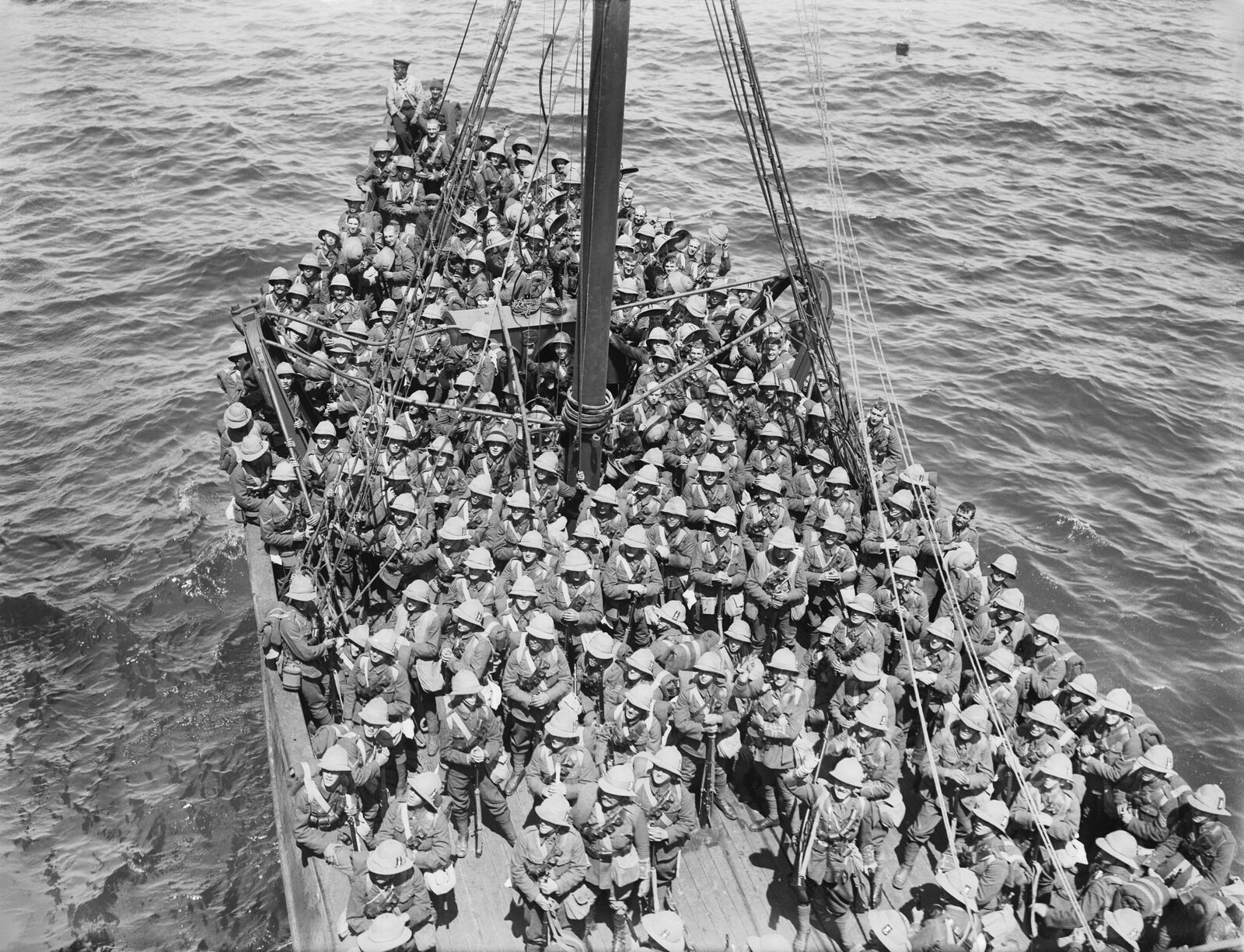
Bromley, the battalion's adjutant, was among the officers who rallied the survivors, cut the wire and pushed inland to take the cliffs above the beach. He was wounded but stayed in the fight. The cost was appalling: of roughly a thousand men, the battalion lost more than half as casualties in seizing the position. So conspicuous was the courage that the army decided six members of the regiment should receive the Victoria Cross. Under the rule that allowed a unit to elect its own heroes, the men themselves were balloted to choose the recipients, and Bromley was one of the six. The phrase "six VCs before breakfast" passed into British military legend.
Gully Ravine and a Last Voyage
Bromley did not leave Gallipoli to recover in comfort. Promoted to acting major in June 1915, he took command of the battalion during the Battle of Gully Ravine and was wounded again, a bullet to the knee that forced his evacuation to Egypt. He could have stayed safely behind the lines. Instead, impatient to return to his men, he took passage back to the peninsula aboard the troopship Royal Edward.
On 13 August 1915, in the eastern Mediterranean between Alexandria and the Aegean, the Royal Edward was struck by a torpedo fired by the German submarine UB-14. The ship went down in a few minutes, taking with it more than 800 lives. Bromley, the strong swimmer, was last seen in the water helping others to safety. His body was recovered but could not be revived. He was 36. With no grave, he is remembered on the Helles Memorial in Turkey, which looks out over the very beaches where he had won his Cross.
Remembered in Seaford
The Victoria Cross was gazetted posthumously on 15 March 1917. In Seaford, Bromley's name was cut into the war memorial, a brass plaque was placed in St Leonard's Church, and a residential road on the eastern side of the town, Bromley Road, was named in his honour.
A century after his death the town marked the centenary directly. On 16 August 2015, a Victoria Cross commemorative paving stone, part of a national scheme to honour every First World War VC in his home community, was unveiled at the Seaford war memorial. The ceremony, arranged jointly by East Sussex County Council and Seaford Town Council, drew councillors, serving and veteran members of the armed forces, cadets and members of Bromley's own family, with the unveiling performed on behalf of the Lord Lieutenant of East Sussex.
For a seaside town better known for its smugglers and its chalk cliffs, the stone is a quiet reminder that Seaford sent its own to one of the bloodiest mornings of the war, and that one of them came home only in name, carved in granite at the top of Sutton Park Road.
Sources
- Cuthbert Bromley, Wikipedia
- Victoria Cross: Major Cuthbert Bromley VC, Seaford Town Council
- Cuthbert Bromley VC, WW1 East Sussex
- Seaford War Memorial, War Memorials Online
- Project archive: `Thoughts-Ideas-Expansion/archives/seaford-sussex-co-uk.md` (Seaford's Blue Plaques, seaford-sussex.co.uk)